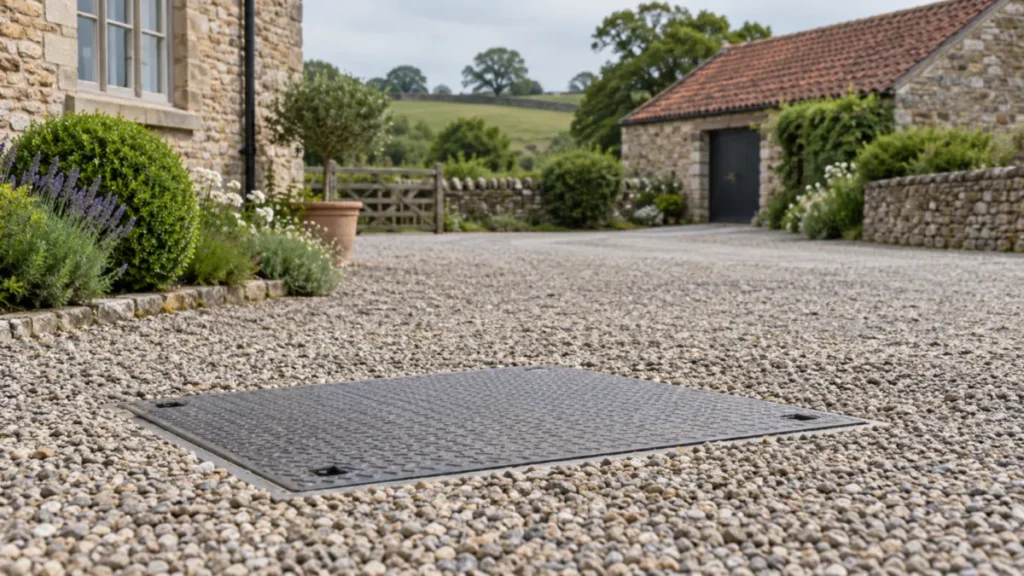
Why covers matter
A septic tank is a deep chamber of sewage. Falling into one can be fatal, and the gases inside, including hydrogen sulphide and methane, are dangerous in their own right. A sound, secure cover keeps people, children and animals out. Never climb into a septic tank or lean in to look; leave inspections to someone equipped to do them.
Signs a cover needs replacing
Cracks, crumbling edges, rusted or rotten frames, a lid that rocks or sinks when stood on, or a makeshift cover such as a paving slab or board. Old concrete and timber lids are common on older tanks and often aren't up to the job any more.
Strong enough for where it sits
A cover in a lawn only needs to take people walking over it. One in a driveway or yard has to take cars, tractors or delivery lorries. Access covers are made to different load classes, so choose one rated for whatever passes over it. If vehicles drive near the tank, it's worth checking the tank itself can take the load too.
Keep covers accessible
Covers that are buried under turf, gravel or patios have to be found and dug out before every empty or inspection, which adds time and cost. Keep them at ground level and visible. Lockable covers are worth considering where children play nearby.
Smells around the cover
A faint smell on a warm day can be normal. A strong, persistent smell can mean a poor seal, a damaged cover, a full tank or a blocked vent, and is worth looking into.
Want a clear answer for your property?
Tell us what's happening and roughly where you are. No need to know what type of system you have.