Regulatory points checked against GOV.UK guidance on the general binding rules for small sewage discharges in England, October 2026.
Why treatment plants need servicing
A treatment plant uses air, pumped in by a blower or compressor, to feed the bacteria that clean the water. If the air supply fails, a pump stops, or a filter clogs, treatment drops off and poorly treated water goes to the drainage field or watercourse. The general binding rules say your system should be regularly maintained in line with the manufacturer's instructions, and that anyone who maintains it must be competent.
What a service covers
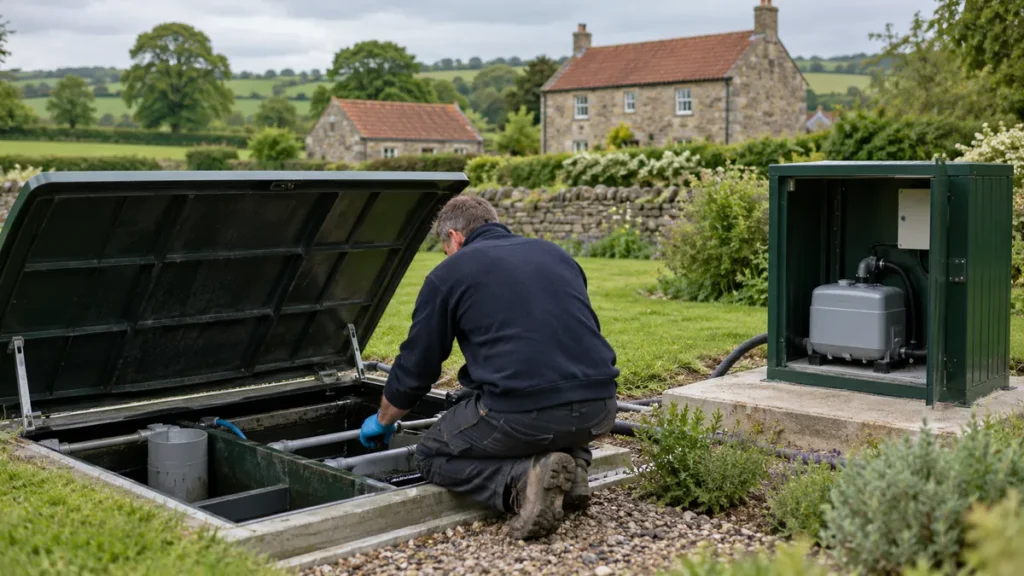
A typical service checks and cleans the blower or compressor and its air filter, the diffusers, any pumps and floats, and the high-level alarm. Sludge levels are measured to plan the next empty, and the treated water leaving the plant is looked at for clarity and smell. Anything worn or failing is noted, with what it means and what it costs to fix.
How often
Most manufacturers recommend a service at least once a year, and some every six months. Plants serving several homes, holiday lets or businesses usually need more frequent visits. Check the manual for your model; if you don't have it, the make and model are usually on a label inside the lid.
Servicing and emptying
A treatment plant still needs desludging at least once a year, or as the manufacturer recommends. Booking the service and the empty together saves a visit.
Signs your plant is overdue
An alarm sounding, a blower that's silent or unusually noisy, smells near the plant, cloudy or grey water at the outlet, and wet ground over the drainage field are all reasons to get it looked at. Don't switch the plant off to stop an alarm: without air, the bacteria die back and treatment stops.
Keep a record
Keep a note or certificate from each service. If you sell, the buyer will want to see how the system has been looked after.
Want a clear answer for your property?
Tell us what's happening and roughly where you are. No need to know what type of system you have.