Regulatory points checked against GOV.UK guidance on the general binding rules for small sewage discharges in England, October 2026.
What "shallow dig" means
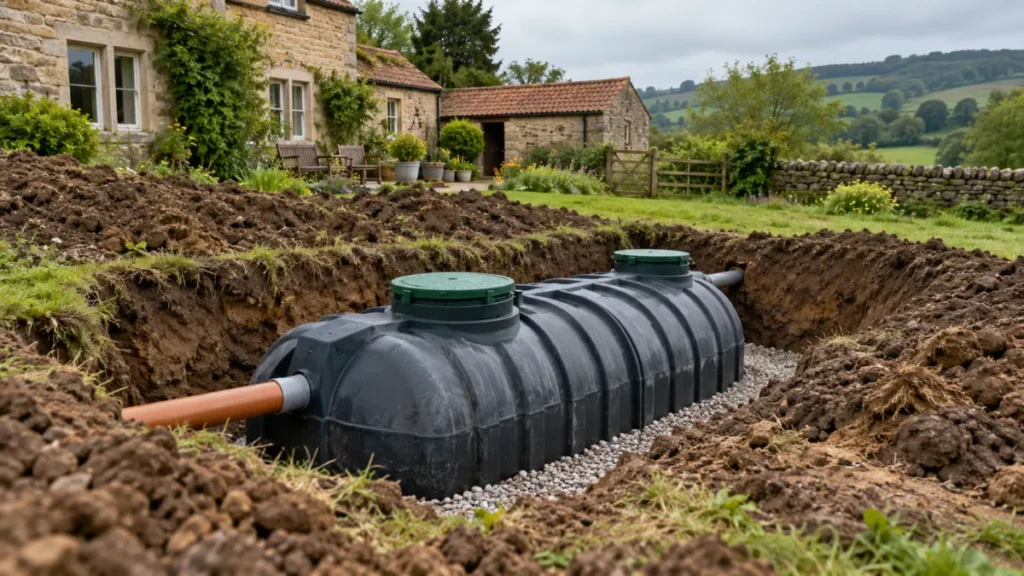
A shallow dig unit is a septic tank or sewage treatment plant designed to sit higher in the ground than a standard unit, so the excavation is shallower. They're usually wider and lower in shape to hold a similar volume.
When a shallow dig unit makes sense
High water tables. Digging deep into waterlogged ground is slow and expensive, and a deep hole can fill with water as fast as it's pumped out. Low-lying areas such as parts of the Vale of York and the Selby district are good examples.
Rock. Where bedrock is close to the surface, breaking out a deep hole can cost more than the unit itself.
Shallow inlet pipes. If the drain from the house arrives close to the surface, a standard deep tank can mean the outlet ends up too deep for the drainage field, or a pump is needed. A shallow unit can keep everything flowing by gravity.
Tight or sensitive sites. Less excavation means less spoil, smaller machinery and less disruption to gardens and access.
What doesn't change
A shallow dig unit still has to meet the same rules as any other. Septic tanks must not discharge straight to a watercourse, so they still need a drainage field, and the drainage field still needs suitable ground, which a percolation test checks. A new or replacement system normally needs Building Regulations approval, and tanks and plants should meet the relevant British Standard.
Is it right for my property?
It depends on the ground, the depth of the incoming drain and where the treated water can go. A site assessment looks at all three before a unit is chosen.
Want a clear answer for your property?
Tell us what's happening and roughly where you are. No need to know what type of system you have.